“Unnecessary move” or “good move”? Indian chess grandmaster comments on FIDE’s latest ‘experiment’ | Chess News

New Delhi: Getting an official rating from FIDE, the main governing body of chess, has never been an easy task. Players must compete in FIDE-rated tournaments, which are organized under strict regulations and often require travel, entry fees and ongoing preparation. To earn a rating, players need to face already-rated opponents and achieve the required performance in rated matches.However, this tradition may soon change.In a sweeping policy shift that has sparked a profound existential debate, FIDE and the governing body’s official commercial partner, the World Chess Federation, recently launched a “first-ever ratings experiment.” This two-year pilot program will allow casual enthusiasts to earn their first official OTB Blitz and Quick Rating entirely through online play on worldchess.com. It’s a bold attempt to democratize a historically insular sport, as the governing body aims to expand the current number of 500,000 rated players worldwide into the millions so that every Tom, Dick and Harry has a chance to earn their first FIDE rating.To manage this new digital frontier, FIDE plans to adopt an AI-driven fair play screening framework and specialized technical coefficients designed to align online performance with physical standards. To protect the upper echelons of the sport, the governing body has also installed a regulatory firewall and the rating of these online hatches will be strictly limited to 1,800 Elo.Although FIDE intends to launch the program in July this year, after a period of community review, the Indian grandmasters who are spearheading the modern chess renaissance are locked in an intense mental tug-of-war over the decision.For some, it represents a visionary dismantling of economic barriers; but for others, it’s a dangerous compromise on the game’s ultimate currency, which lies in the integrity of the rating system.
FIDE’s “unnecessary move”?
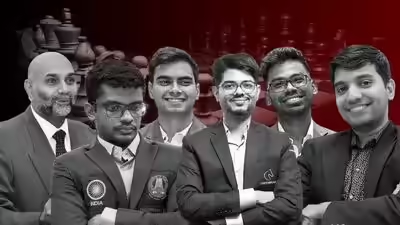
Several Indian grandmasters believe that the line between online and offline chess must remain completely sacred. In an exclusive interaction with TimesofIndia.com, Grand Master (GM) SL Narayanan spoke out against it.“I think this is an unnecessary move by FIDE. You can’t combine online competitions and then convert the ratings into full ratings because the rules of online and offline chess are different,” he said. “For casual players they will see this as a welcome move, but the real issue is the impact it may have on the credibility of the rating system.”This sentiment was strongly echoed on X (formerly Twitter) by renowned coach GM Srinath Narayanan, who expressed deep reservations about cybersecurity. “There are serious doubts about the effectiveness of fair play checks. Online play and full scoring should not be confused,” he wrote.GM SP Sethuraman also highlighted to “The introduction of official online ratings that can be converted into OTB ratings may create more noise and uncertainty. While the intention is to make chess more accessible, I hope FIDE will proceed with great caution. “General manager Abhimanyu Puranik struck a more relaxed but equally cautious tone, telling the site, “Generally speaking, it’s not great to link online games and OTB games, but the ratings themselves are starting to be so low that it won’t change much.”“It’s a very difficult decision to doubt a player based solely on their actions”Speaking to TimesofIndia.com, General Manager Shyam Sundar M, one of Chennai’s best-known coaches, admitted that he was surprised by the news and weighed the massive operational shift against the dark cloud of digital cheating:“The good news is that FIDE is trying some new initiatives… However, combined with the overall ratings of online chess, I’m not sure. I mean, this is also done without a physical chessboard. I understand, like a hybrid system. There is some truth to this. “Shyam Sundar suggested that a hybrid system, where players gather in physical area lobbies monitored by local arbitrators and 24-hour Zoom surveillance, would be safer and equally economical for organizers.He expressed his core concerns about anti-cheating algorithms, adding: “I firmly believe that even an innocent person should not be punished. It’s not easy, it’s a very difficult decision to doubt a player just based on actions, quality of play, in two, three or four games. “Still, he remains open to the future, adding, “Maybe based on AI, or even server-based. Maybe something like a browser with AI, maybe that’s possible. If it happens, maybe it’s a good thing.”
grandmaster Praveen Tipsay welcome this initiative
In stark contrast, Arjuna laureate and senior general manager Pravin Thipsay hailed the move as a visionary leap, noting that less than 1% of the world’s chess enthusiasts can actually afford to participate in physical, graded tournaments.“I think FIDE has taken a bold step… there are tens of millions of chess players… they play chess online, they play regularly because Karpov created it. One-third of the people in the Western world play chess almost every day, but they play on computers and then they go away from the mainstream. Somewhere, the barrier between online chess players and board chess players has to be removed and this is a good step towards that goal,” he told TOI.Tipsey acknowledged that the system could face serious problems if cheating goes unchecked or if rating coefficients are calculated incorrectly, noting that FIDE’s previous coefficient changes for under-18 players “failed at their own peril.” However, he believes the 1,800 cap is a good filter.“If someone goes over 1,700 or 1,750, there’s a good chance that that particular player will try to play chess more seriously and become an all-around player,” he added. “So I think it’s a good move and we’re going to have a lot of players coming to chess tournaments.”The world of chess is at an unprecedented crossroads as FIDE gathers feedback ahead of its final launch. What do you think of this proposal? Let us know in the comments.



























Post Comment