Sports a core pillar of India’s development agenda More Sports News
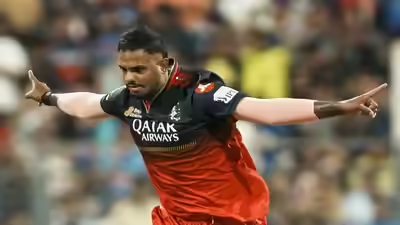
Khelo India’s mission sets a clear and ambitious goal: India must become one of the top ten sports nations in the world by 2036 and among the top five by 2047. By aligning these milestones with the Viksit Bharat vision and the centenary of independence, the mission takes sport beyond the pursuit of medals and positions it as a core pillar of India’s national development agenda.This shift has been reinforced by an 18 per cent increase in sports spending in the Union Budget for 2026-27 compared to the new 10-year Khelo India Mission. It casts a future Olympic bid not as an isolated sporting aspiration but as a statement of India’s economic confidence, institutional maturity and nation-building ambitions.Case in point: In a recent shift in budgetary momentum, the Ministry of Youth Affairs and Sports’ allocation for 2026-27 increased by 18% to Rs 4,479.88 million (revised from Rs 3,346.54 million in 2025-26), the largest year-on-year increase in the history of the ministry.At a time when unemployment continues to be a larger topic of public and private sector discussion across the country, the government-driven thought bubble surrounding the development of the sports sector over the next decade certainly has larger implications. Investing in sport can simultaneously address youth engagement, job creation, health and fitness while nurturing new economic sectors.Deloitte-Google’s “Think Sports” report predicts that the Indian sports market will reach US$130 billion by 2030, with a compound annual growth rate of 14%, almost twice the growth rate of India’s GDP. The report projects that 10.5 million jobs will be created by 2030 and indirect tax revenues will reach $21 billion.From the above budget allocation, Sports Authority of India will get Rs 917.38 crore, National Sports Federation (NSF) will get Rs 425 crore and Khelo India itself will get Rs 924.35 crore – spread across training centres, coaching, sports science and grassroots competitions (Khel Mahakumbhs).As far as cricket is concerned, in the last five years, the game has broken all the barriers of the past, bringing in nearly Rs 4,600 crore with the launch of the Women’s Premier League (WPL) – the first T20 women’s league with gender equality and equal pay as its pillars.The IPL has underlined the larger idea of ’Digital Bharat’ by selling media rights – internet rights have surpassed the value of traditional TV rights, creating a record-breaking revenue cycle.However, cricket aside, the tide is really turning, if only gradually, in the non-cricketing sphere.While sports-specific private equity data – especially outside cricket – remains thin and fragmented, broader Indian private equity and venture capital activity remains deep, providing sports-related industries (technology, infrastructure, media, D2C sportswear, apparel) with a large domestic capital pool to draw from.Private sports leagues such as kabaddi, football, volleyball, table tennis and hockey are establishing independent sponsorship and merchandise streams, reducing – even if only slightly – cricket’s almost complete share of commercial revenue, underscoring the potential for the future.Sustained double-digit growth compounded rapidly. With the sports economy expected to grow at 13% to 14% annually (significantly exceeding nominal GDP growth), the industry is steadily becoming a more meaningful contributor to the Indian economy. 60% of the sporting goods produced in India are exported, and the industry directly employs nearly 500,000 people.Is there any flip side to the narrative? The northern districts of Jalandhar (Punjab) and Meerut (Uttar Pradesh) alone account for 75% to 80% of the national production. While it represents the idea of the cluster economy story, it is also a concentration risk worth being wary of in order to make way for diversification opportunities.Technology and artificial intelligence represent another major opportunity. If the Deloitte Google report is anything to go by, this segment is expected to surpass the $1 billion Indian market at a CAGR of 19% by 2030, spanning fan engagement platforms, performance analytics and broadcast automation.The country’s existing strengths in software and analytics have given a shot in the arm to exports of sports technology services, something the cricket industry has already begun to embrace. Here, the government’s broader AI mission, which further carries a five-year spending of $1 billion (approximately Rs. 10,300 Cr), could drive new initiatives.Last but not least is the focus on modern sports infrastructure. The growing need to promote sports across the country for various reasons has only accelerated the development of infrastructure.The role of the 2030 Commonwealth Games in Ahmedabad is likely to be much greater than that of the 1982 Asian Games and the 2010 Commonwealth Games for New Delhi because of the focus on infrastructure development in New Delhi. In Mumbai, the Maharashtra state government has loudly called for more sports venues on the outskirts of the city. Odisha has made significant progress in sports and sports infrastructure in the last decade.At an alarming rate, private investors are eyeing the growth of sports infrastructure across the country for business opportunities — all of which could serve as potential catalysts in the service of bigger ideas.India’s sports economy, at this moment, is a whirlpool of ocean. It’s time to adjust the sails and forge ahead.






















Post Comment