Shadow of the Falklands, Maradona’s legacy: England vs Argentina – The fate of this match ‘owed’ to Lionel Messi | Football News
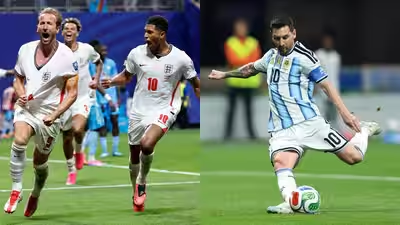
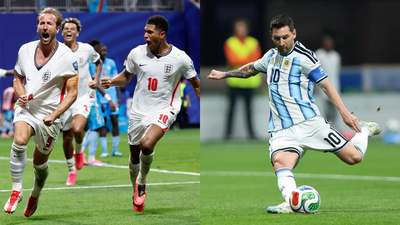
“Y ya lo ve, y ya lo ve. El que no salta, Es un ingles!”“Look now, look now, those who don’t dance are British.”This is one of the most common chants among Argentinian fans and players. It follows the team wherever it goes, regardless of the opponent. Argentinian fans sang the song in the stands. Players join after winning. It has become part of the image of Argentine football.England didn’t even need to be the opponents for Argentina supporters to chant the slogan. However, as Argentina prepares to face the Three Lions fifa world cup Those words will carry even more animosity and emotion during the 2026 semi-finals in Atlanta on Thursday (IST).Argentina versus England is a rivalry that spans generations. It is rooted in football, history, politics and colonialism, and after an international career of more than two decades, more than 200 appearances and 125 goals, Lionel Messi The World Cup will be against England for the first time as defending champions Argentina will try to prevent Thomas Tuchel’s England from reaching the World Cup finals for the first time since 1966.The rivalry began in 1962 and has since sparked controversy, red cards and some iconic goals.Political tensions and military conflicts, particularly those surrounding the 1982 Falklands War, continue to affect relations between the two football-mad nations. Argentinian players and supporters still refer to the conflict in football songs.The celebrations continued in the dressing room after Argentina defeated Switzerland in the quarter-finals. Video shared by the Argentine Football Association showed the team singing together. An ode pays tribute to Diego Maradona and Lionel Messi, while also mentioning the Falkland Islands.“For Malvinas, for Diego, for Leo’s end.”“For Malvinas, for Diego, for Leo’s last game (tournament).”Las Malvinas is the Argentinian name for the Falkland Islands, a British territory about 300 miles (480 kilometers) off the east coast of Argentina.In 1982, the two countries went to war over the island issue. The conflict lasted 74 days and ended with Argentina’s surrender. A total of 649 Argentine soldiers, 255 British soldiers and 3 Falkland Islands residents were killed, and more than 2,300 people were injured.Even today, the Falklands remain a symbol of Argentine nationalism.A look at the fiercest rivalries in international footballIt’s a rivalry shaped by decades of pain, where football and history often collide.The first World Cup meeting took place in 1962, but four years later the rivalry really intensified.1962: England 3-1 Argentina (Rancagua, Chile – group stage)The game was relatively uneventful compared to the rest of the game.Goals from Ron Flowers, Bobby Charlton and Jimmy Greaves gave England a 3-0 lead before Argentina grabbed a late consolation.Both teams ended the group stage with one win, one draw and one loss, but England advanced on goal difference.England were then eliminated by Brazil in the quarter-finals.1966: England 1-0 Argentina (Wembley, England – quarter-finals)It remains the only World Cup title won by England.The quarter-final remains in Argentinian memory as a game in which they felt they had been robbed, claiming Geoff Hurst’s winning goal was offside.That wasn’t the only controversy at the game.Argentina captain Antonio Latín committed two fouls in three minutes and was sent off in the 33rd minute. He refused to leave the field, causing the game to be delayed for nearly eight minutes.England ended up winning a tight game.After the game, England manager Alf Ramsey described Argentina as “animals” and instructed his players not to swap shirts.The game also played a role in the subsequent introduction of yellow and red cards, highlighting the need for better control in such an intense game.1986: Argentina 2-1 England (Mexico City, Mexico – quarter-finals)The match took place four years after the Falklands War and remains a defining chapter in the rivalry. Diego Maradona hit the ball past Peter Shilton to score the infamous ‘Hand of God’ goal, then just four minutes later he broke through the England defense on his own to score the ‘Goal of the Century’. Argentina eventually won the World Cup.1998: Argentina 2-2 England (Argentina won 4-3 on penalties) (Saint-Etienne, France – Round of 16)The game is best remembered for David Beckham’s red card after kicking Diego Simeone.Gabriel Batistuta and Alan Shearer exchanged penalties before Michael Owen scored one of England’s best World Cup goals solo.Javier Zanetti equalized before half-time.England kept pressing Argentina after Beckham was sent off and even thought Sol Campbell scored the winning goal before his goal was disallowed.Argentina advanced after winning a penalty shootout.2002: Argentina 0-1 England (Sapporo, Japan – Group Stage)Four years later, Beckham got a chance at redemption.England won when Beckham awarded a penalty after Mauricio Pochettino fouled Michael Owen.England then beat Denmark before losing to Brazil in the quarter-finals. Messi gets the England date the football world has been waiting for Lionel Messi has achieved almost everything in football. He won the World Cup, two Copa Americas, multiple Champions League titles and just about every individual accolade the sport has to offer. Yet he had never faced England in his career.That changes on Thursday when Argentina take on England in the World Cup semifinals in Atlanta.The Argentine Football Association described this as “the fate of this game belongs to Messi.”Many of Argentina’s iconic No. 10s have experienced this kind of competition before him. Antonio Lartin did it. Diego Maradona made it his own. Ariel Ortega has been through this, too.Now it’s Messi’s turn, in the twilight of his career.Just like that, 24 years after England and Argentina last met at the World Cup, one of football’s fiercest rivalries is back.For Messi, this will be his first match against England. For Argentinian fans, from Buenos Aires to all corners of the world, there is hope that this will not be the last time he wears an Argentina jersey.




























Post Comment