India’s foreign exchange reserves explained: What they are, who owns them and how the Reserve Bank of India uses them
Competitive Exam Commentator | Indian Economy
Why is it in the news?
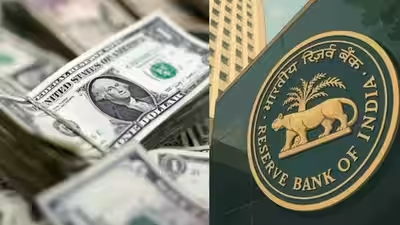
The Reserve Bank of India said on Friday that India’s foreign exchange reserves increased by US$7.26 billion to US$674.193 billion in the week ended July 3. In the last reporting week, Forex Kitty fell $5.654 billion to $666.933 billion. Before the outbreak of the conflict in the Middle East, the RMB exchange rate had risen to a record high of US$728.494 billion in the week ended February 27 this year, but the Indian rupee exchange rate had fallen for several consecutive weeks due to pressure on the rupee and the depreciation of the RMB. reserve bank of india had to intervene in the foreign exchange market by selling dollars. Prime Minister Modi Since May 11, the central bank has repeatedly publicly called on citizens to save foreign exchange by reducing overseas travel, limiting fuel use, and refraining from buying gold for a year.In this context, let’s understand what exactly foreign exchange reserves are, who owns them and when the Reserve Bank of India can tap them.
In simple terms, this concept
Foreign exchange reserves are the stock of foreign currencies, gold and other international assets held by a country’s central bank to fulfill its external payment obligations and maintain the stability of its own currency. Think of them as a country’s foreign currency emergency fund, used to pay for imports, repay foreign debt and defend the rupee when it comes under pressure.A common misconception is that these reserves are just idle “government money.” In fact, the RBI builds these reserves by using newly created rupees to purchase foreign currency from the market. So while reserves are national assets, they also constitute a rupee liability on the RBI’s own balance sheet. This is why the Reserve Bank of India, not the Finance Ministry, decides how and when reserves are deployed, and why reserves cannot simply be transferred to the government to fund the budget.
how it works
India’s foreign exchange reserves consist of four parts:
- Foreign Currency Assets (FCA): It accounts for the largest proportion and mainly holds U.S. Treasury bonds and foreign central bank deposits. In the week ended July 3, foreign exchange assets (the main component of foreign exchange reserves) increased by US$4.51 billion to US$545.578 billion.
- Gold reserves: Gold reserves increased by $2.6 billion this week to $105.2 billion.
- Special Drawing Rights (SDR): The country’s Special Drawing Rights holdings with the International Monetary Fund also increased by $65 million to $18.623 billion. The Special Drawing Right is an international reserve asset created by the International Monetary Fund and is denominated in a basket of five currencies.
- Reserve tranche position (RTP): India has its own quota-linked status with the International Monetary Fund, which it can avail without conditions or fees.
The RBI accumulates these assets through market intervention (purchasing dollars when inflows are excessive), interest income from existing reserves, and financing from multilateral institutions. When the rupee depreciates sharply, they attract investors primarily to sell dollars to calm volatility rather than defend a fixed target.
Main institutions and legal framework
- Reserve Bank of India Act, 1934: Grants statutory authority to the Reserve Bank of India to hold and manage foreign exchange reserves as part of its monetary and monetary functions.
- Foreign Exchange Management Act (FEMA), 1999: It replaced the old FERA and manages all foreign exchange, current account and capital account transactions in India.
- International Monetary Fund (IMF): Manages the Special Drawing Rights and Reserves component; India is a founding member and adheres to the International Monetary Fund’s standards for the release of reserve reporting information.
- Ministry of Finance: It is not a custodian of reserves but coordinates broader external sector policies with the Reserve Bank of India.
indian background
India has one of the largest reserve inventories in the world, far behind China but among the top in the world, which provides it with good import protection. Meanwhile, the Reserve Bank of India’s revised FCNR-B deposit scheme is expected to attract $40-50 billion in new deposits, and banks will strengthen services to NRI customers. To date, the banking industry has raised approximately US$3-4 billion through FCNR-B deposits. The scheme, targeted at non-resident Indians, is one of the RBI’s tools to rebuild reserves after a fall caused by conflict in the Middle East and related rupee pressure. Historically, reserves have played a decisive role in past crises, most notably in 1991, when India had to pledge gold to raise emergency loans, and in 2008, when reserves mitigated the global financial crisis without the need for an IMF bailout. Information box
- Current foreign exchange deposit base: $674.19 billion (week ending July 3, 2026)
- All-time high: $728.494 billion (week ended February 27, 2026)
- custodian: reserve bank of india
- Four components: FCA, Gold, SDR, Reserve Segment Positions
- Applicable law: Reserve Bank of India Act 1934, Federal Emergency Management Agency Act 1999
- Maximum components: Foreign currency assets (approximately 80-85% of total reserves)
Main line exercises: “Foreign exchange reserves are a national asset and a liability of the central bank.” Discuss this statement in the context of the composition and management of India’s foreign exchange reserves and examine the limitations of its use for fiscal purposes.
test yourself
Q1. Which of the following are components of India’s foreign exchange reserves?
- foreign currency assets
- Gold held by Reserve Bank of India
- special drawing rights
- fiscal deficit
Choose the correct answer:(a) 1, 2 and 3 only(b) 1 and 4 only(c) 2 and 3 only(d) 1, 2, 3 and 4Answer: (1)Q2. Reserve tranche positions refer to:(a) India’s gold holdings at the World Bank(b) The portion of the IMF quota that is unconditionally available to India(c) India’s loans from the International Monetary Fund(d) India’s external debt to other countriesAnswer: (b)Q3. Which law primarily governs Forex trading in India today?(a) Oral sex, 1973(b) Reserve Bank of India Act, 1934(c) Federal Emergency Management Agency, 1999(d) Banking Supervision Act, 1949Answer: (3)Q4. The largest components of India’s foreign exchange reserves in value terms are:(1) Gold(b) Special Drawing Rights(c) Foreign currency assets(d) Reserve positionAnswer: (3)Q5. The Reserve Bank of India mainly uses foreign exchange reserves to:(a) Direct funding of union budgets(b) Intervene in the currency market and stabilize the rupee(c) Payment of salaries to government employees(d) Provide funding for state government programsAnswer: (b)
Must-know terms
- Foreign Currency Assets (FCA): Assets denominated in dollars, euros, yen and pounds make up the majority of foreign exchange reserves.
- Special Drawing Rights (SDR): Reserve assets created by the International Monetary Fund are priced against a basket of currencies.
- Reserve tranche position (RTP): India made an unconditional withdrawal from the International Monetary Fund.
- Federal Emergency Management Agency, 1999: Indian Foreign Exchange Transactions Regulation Act.
- Imported cover: The number of months a country’s reserves can support imports is a key adequacy indicator.




























Post Comment