The Making of the 2026 Wimbledon Champion: The Secrets Behind Jannik Sinner’s Unparalleled Big Match Gear | Tennis News
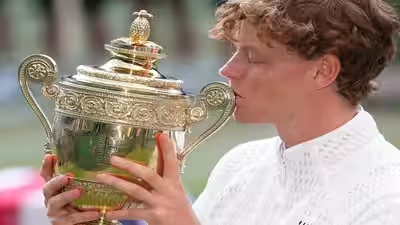
LONDON: Alexander Zverev missed a forehand early in Sunday’s second set tie-break Wimbledon After a powerful serve from Jannik Sinner in the final, the Italian turned to his penalty area and clenched his fists. Coaches Darren Cahill and Simon Vagnozzi were already on their feet, cheering on their players. This was the first real breakthrough for the Germans game The 24-year-old felt it immediately about two hours into the game. It’s time to shift gears.That’s exactly what he did over the next 10 minutes to equalize. His serve was on target, his forehand was more powerful, and the version Sinner reserved for the biggest moments came out. There was one more stage in the game when he reached for that gear. At the beginning of the fourth set, the wind was raging and the game had been going on for three hours. Sinner fell behind 1-2, 15-30. At the other end, Zverev knew he had to seize the moment if he was to push the final into a fifth set. Sinner turned his racket, stepped to the free throw line, and hit exactly the game-winning three-pointer the situation demanded.Every player on tour knows that the Italians are on another level. Few games illustrated this better than last year’s Wimbledon final, when he arrived on the pitch following a heartbreaking loss to Carlos Alcaraz at Roland Garros. He played alongside his 29-year-old opponent for much of Sunday’s game, knowing he always had other gear if the game called for it.After the final, Zverev acknowledged the five-time Grand Slam champion’s dominance in the competition, calling Sinner “the best player in the world” and saying there were only two, maybe three, players, Alcaraz, Novak Djokovic and himself, who can keep pushing the Italians.However, the ability to improve is not just a product of confidence. It became even more acute during one of the most difficult years of Sinner’s career.If last year the world number one came to Wimbledon in a low mood after conceding three championship points in the French Open final, this year he returned to SW19 with different scars. Sinner, chasing a career Grand Slam in Paris, led Juan Manuel Cerundolo 5-1 in two sets in the second round, but his energy levels plummeted and he ended up losing in five sets.The collapse immediately raised questions. What happened to the world’s No. 1 player? Is the problem physical? Spiritual? Or a combination of both?Sinner has never publicly explained the specifics of what happened in Paris, but he underwent a series of tests in Milan shortly afterwards before heading to London to defend his title. He later told Italian media at Wimbledon that he now knew what caused the collapse and was doing everything he could to ensure something like this never happens again.This perspective transcends the physical plane. “If you don’t win a Grand Slam, it’s not a failure,” he said Sunday. “We talk about five Grand Slams, but at the end of the day, it’s just five out of so many days. You just want to enjoy it. Today was a very tough day. Even if I lost, it’s still a great day. Playing in a Grand Slam final is so rare and special.”The defending champion’s title defense got off to a rocky start, taking five sets to defeat Serbian Miomir Kekmanović in the first round. Cahill, who had planned to stop coaching last year but was persuaded to stay by Sinner, said the world number one arrived in London 12 days ago to play in one of the hottest Wimbledon tournaments on record.“Look, he’s a redhead who lives in northern Italy and grew up in the snow and the Alps. Hot weather is a little different for him than most people,” Cahill said.“The Australian” said that what impressed him most was not that Sinner was knocked down, but how quickly he got back to work.“We got the call. OK, kids, what are we doing? Let’s get back on the field. What are we trying to do? What’s the plan? Where are we going? What do we need to do to get better?” he said.This may be the sinner’s greatest gift. His serve can overwhelm opponents, his forehand can dominate, and his court coverage can suffocate opponents, but none of that defines him as much as his reaction to adversity. Paris exposed the weaknesses, Wimbledon revealed the answers. The extra gear he discovered against Zverev on Center Court wasn’t born in the final. It’s forged in disappointment, perfected on the practice field, and unleashed precisely when it’s needed in two weeks of the most important competition.



























Post Comment