IIT Roorkee says it will issue annual advisory after social media criticized student protests over communication issues


Indian Institute of Technology (IIT) Roorkee has clarified that the advice circulating among members of the institute is not a new directive or policy, following criticism on social media over claims that students were asked not to support the ongoing online student protests.After the announcement sparked public discussion, a clarifying statement was issued on July 21, 2026. According to the institute, the communication is a routine internal consultation shared with students, faculty and staff at the beginning of each academic session and is based on the institute’s existing Notice of Conduct Rules. Institute question clarificationIn an official statement issued by IIT Roorkee Media Cell, the institute said that the communication mentioned is part of its regular practice and should not be seen as introducing any new policy.“The information referred to is an internal advisory circulated among students, faculty and staff at the beginning of every academic session. Similar advice is regularly issued every year in accordance with the Institute’s existing Notified Conduct Rules and does not constitute any new directive or policy. The information should not be misunderstood or taken out of context,” the statement said. The statement was issued by Sonika Srivastava, Head of Media Unit, IIT Roorkee.
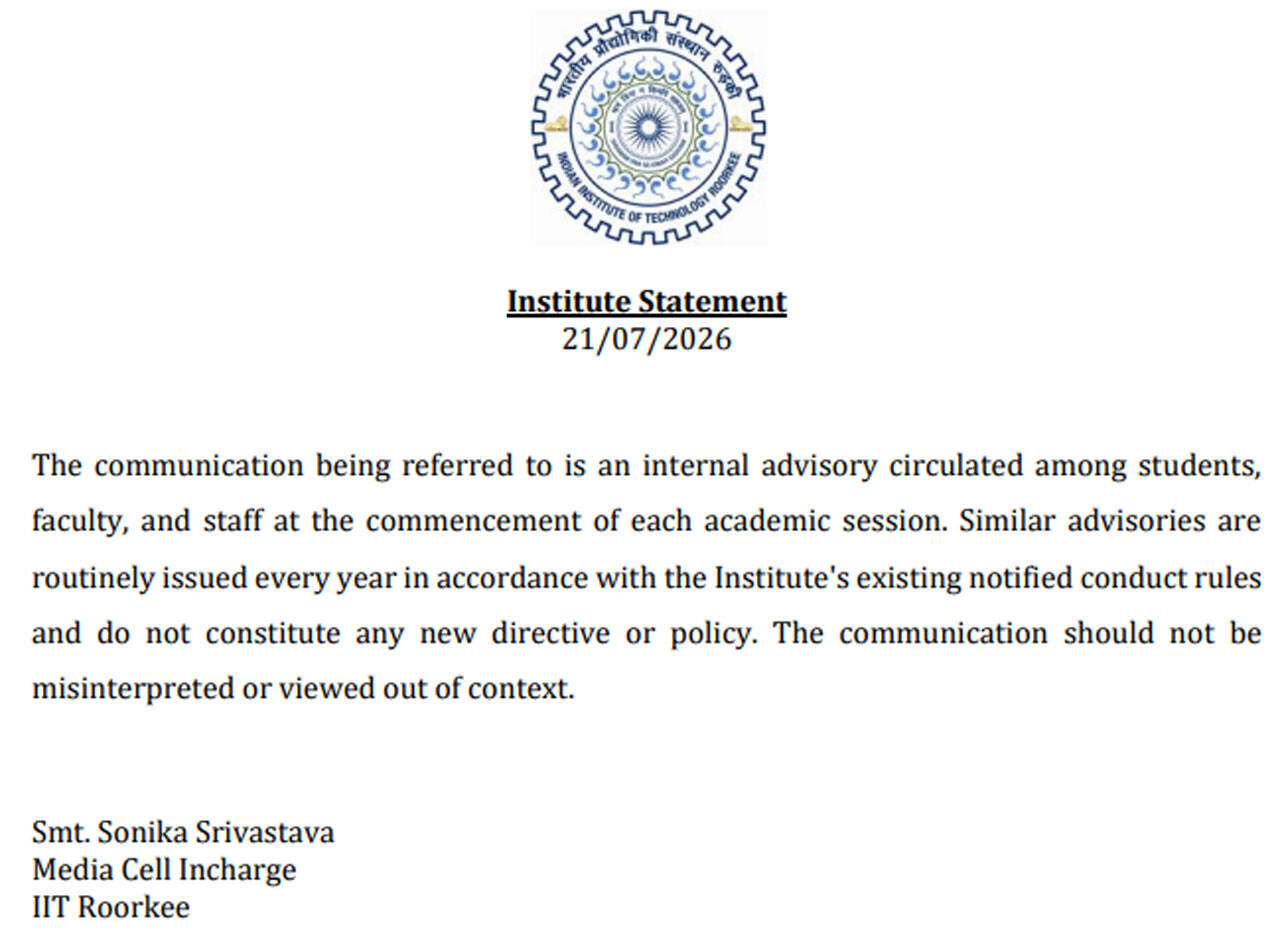
IIT Roorkee clarifies advice amid social media controversy, says communication is not new policy
The suggestion attracted attention on social mediaThe clarification came after the advisory attracted attention on social media, with some users interpreting it as a new directive asking students not to support ongoing student protests through their personal social media accounts. The institute responded that the advice was not new and was consistent with existing institutional rules of conduct communicated at the beginning of each academic session. IIT Roorkee did not announce any changes in its rules of conduct in the clarification. Instead, it reiterated that the consultation form is part of its standard communications process and should be read in the appropriate context.

























Post Comment